Adria Arjona Refuses to Be Limited by Hollywood’s Idea of a Latina Actress (Exclusive Interview)
In Onslaught, Adria Arjona steps into the kind of role Latina actresses are rarely afforded: a hero whose Latinidad is her superpower, not her entire story

Credit: AP Photo/Chris Pizzello | Associated Press

There’s something almost surreal about watching Adria Arjona become a one-woman army in Onslaught, the sci-fi action film that opened in theaters nationwide on Sept. 4.
Best known for Hit Man, Blink Twice, and the 2022 reboot of Father of the Bride, Arjona has played plenty of confident, complicated, and powerful women. But we’ve never seen her like this. As Celeste, a combat veteran and Army sniper protecting her young daughter from genetically engineered super soldiers, she isn’t the hot Latina love interest, the damsel in distress, or the supporting role. She’s the hero.
Watching her throw punches and take down soldiers with what a friend described as “the physicality of a female Rambo” felt significant beyond how much fun the movie is. Onslaught gives Arjona something Latina actresses are rarely afforded in Hollywood: the freedom to play a woman whose story has nothing to do with being Latina. Any actress of any race or ethnicity could have played Celeste. In traditional Hollywood, a white man probably would have.
For decades, Hollywood has treated Latina actresses as though their ethnicity needed to explain their place in a story, casting them as the fiery love interest, the hypersexualized woman, the immigrant, or the sidekick. Few—including Melissa Barrera, Jenna Ortega, and Isabela Merced—have consistently avoided this kind of typecasting.
Onslaught shows what happens when a Latina actress’ Latinidad isn’t the plot point or stereotype. Arjona’s performance suggests the possibilities are expanding—and that Latina actresses can finally occupy roles written for anyone.
When I spoke with Arjona, we discussed taking on a role unlike anything she had done before and how it reflects her own evolution.
“This role scared me, to be honest,” she tells HipLatina. “I think when I read it and then sat down with Adam, he pitched me the whole movie and was so gracious to let me live in his brain for about an hour, which was fun and the reason why I decided to make the movie.”
What scared her was finding Celeste’s strength without flattening her.
“There’s a balance of what I keep seeing and what I don’t want to do. What I don’t want to do is emulate a man and just be tough,” she said. “Women aren’t tough. We are strong, and we could be badasses. But being strong is not all tough.”
Celeste is a single mom who doesn’t have full custody of her daughter. When the child is unexpectedly dropped off, Celeste is alarmed and unprepared. Arjona leaned into that tension to humanize her.
“We have certain stereotypes as Latin American women specifically. We’re spicy. We’re fiery. We’re sexy. We’re this. We’re that,” she says. “And then I look around at my family, and I’m like, ‘I come from a really big family of a lot of women with a lot of very different personalities, and we are all so different that not all stereotypes can define us.'”
Celeste is living in survival mode. Her apartment is littered with dirty dishes and empty beer bottles as she navigates PTSD from war.
“Something interesting for Celeste specifically was the fact that she’s not the best mom. I think we’ve seen Latin women be incredibly nurturing, and we’re like, ‘Oh, Latin women love to cook. They love to clean the house. They’re caretakers,'” she says. “What I spoke to Adam was that I don’t want her to be a caretaker. I don’t want her to be a good mom. She is suffering from post-traumatic stress. She’s all messed up. She doesn’t have the [mental] capacity to deal with a child. And if she does, she needs a week’s notice. You cannot just drop this kid at my house because there’s beer, there’s cigarettes, there’s guns.”
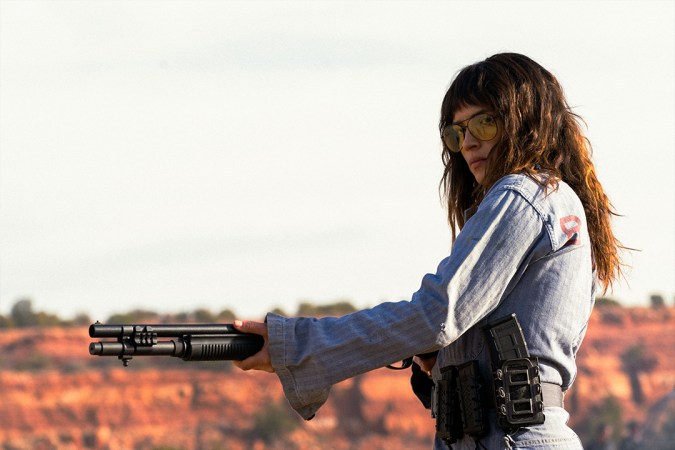
Arjona found Celeste’s strength in the mothers in her own life and in a mother’s ferocity in protecting her child.
“That is the scariest thing in the world because it is feral. It is animalistic. It comes from your gut,” she says. “That’s fucking badass. That’s not tough. That’s incredibly strong … and I’m not a mom, so I was like, ‘where do I find it?’ [But] I have a little brother who is 16 —he’s my baby. He was born when I was 18, and I was like, ‘Oh, that almost feels like I had a child.’ So I really anchored myself in that relationship and in that truth.”
The role also offered freedom because Celeste’s identity never determined the story.
“Never was it a thing about being Latin. We never really touched it,” she says. “It was liberating because I am Latin and I’m so proud to be Latina all the way. I’m the most Latina, but I’m also just an actress. So being tied to an identity sometimes as an actress…you want to be free and open and play in different playgrounds. I don’t want [it] to limit me. I want it to be my superpower.”
Arjona found subtle ways to make Celeste Latina without making Latinidad the point. Hair and makeup helped shape the character, while training prepared her for the action.
“I think the bloodier you get, the more things kind of shift in you. But I had an amazing stunt double. Bethany—she’s incredible,” Arjona says. “Towards the end, the more blood we had, the more stunts I actually had to do because Blake, who played my daughter, was a little scared of the blood.”
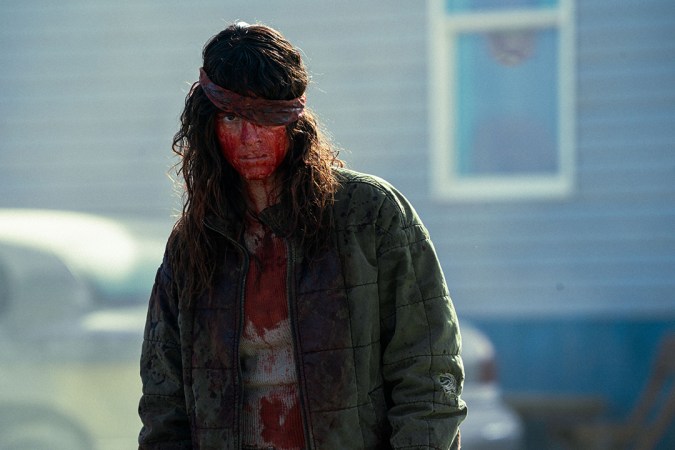
The hardest stunt, she says, involved jumping from a window and running while carrying her daughter. But her growth extended beyond the physical work.
“Five years ago I was quieter and more shy. I wouldn’t necessarily speak up about things,” Arjona says about the kind of actress she used to be compared with. “I’ve worked with enough directors now where they’ve assured me like, ‘Girl, you have really good ideas,’ and they now come to me like, ‘Alright, how do we fix this? How do we do this?’ I think producing has also helped me understand the bigger picture and have a seat at the table.”
She has used that seat as an opportunity to learn.
“The more understanding you have of a director’s vision—what the production value is, what the production is trying to do, how the marketing is—all those details not only make you a better actress, but a better businesswoman,” she says. “And by the way, I’m still very much learning, and I’ll be learning forever. That’s how I want to approach my work.”
In a tender scene Arjona wrote and pitched, Celeste teaches her daughter to eat a burrito with her hands rather than a fork and knife.
“It was just a weird little idea that I had, and I love that moment between her and me. I would’ve never done that five years ago,” she says. “I wouldn’t have done it because I would have been afraid of rejection, and I also wouldn’t have done it because I would’ve been afraid of overstepping…Now I’m not afraid of someone telling me that’s a bad idea. I can take that.”
Onslaught unlocked a strength Arjona hadn’t felt confident enough to tap into: taking up space without fearing she might overpower the room.
“I’m always like, take a step back. I don’t ever want to be too much. And I think with Celeste I was like, ‘F––k it. Whatever. Let’s go.’ It was so liberating—I loved every part of it,” she says.
Latina actresses are often expected to do another kind of work alongside their actual jobs: look beautiful while doing them. Hollywood has historically intertwined their value with beauty and desirability, expecting them to be sexy, feminine, and aspirationally beautiful regardless of what a role requires.
But Onslaught puts all of that on pause. Celeste isn’t concerned with looking beautiful. She’s concerned with surviving.
“There’s an element to her that is completely lost in vanity. She is the least vain human, and there’s so much freedom in that as well,” she says. “There’s too much other stuff to deal with, and Celeste doesn’t have time. Liberating myself from that was me not thinking about it [because] she wouldn’t think about it. I’m also covered in blood, so I was like, whatever.”
That freedom matters. Women are often expected not only to perform a character, but to perform a particular version of femininity—to remain desirable to the male gaze even when the story doesn’t demand it. For Latinas, that pressure carries another layer because beauty, bodies, and desirability can become deeply intertwined with perceived value. Playing Celeste allowed Arjona to make her appearance irrelevant.
Arjona isn’t trying to prove what a Latina actress can be. She’s refusing to limit what she can become. When I ask what she hopes the next chapter of her career looks like, she reminds me that the best chapters are often the ones we couldn’t have imagined.
“I couldn’t have designed this chapter that I’m living right now five or 10 years ago. I would’ve done myself a disservice. I’ll do the same if I say what I want in the next 10 years,” she says when asked what she wants the next chapter of her career to look like. “All I can hope for is to keep working and keep telling stories that resonate with me and hopefully resonate with [other] people. I want to keep telling stories about powerful, badass, cool women and represent and reintroduce what Latina women are and show all sides of it—the stereotypes, the non-stereotypes, the quirky, the this, the that. I eventually want to play every single female in my household—which is hard.”
After years in an industry that has tried to define what Latina actresses should look and sound like, Arjona seems less interested in mapping out who she needs to become than in staying open to new possibilities. Onslaught shows what can happen when a Latina actress is free to surprise us.
This feature is part of our 2026 Latina Heritage Month series, Latina Maxxing.


