The Daniela Avanzini Latinidad Debate Isn’t Really About Her
Who gets to identify as Latine and who gets to be accepted by the community?

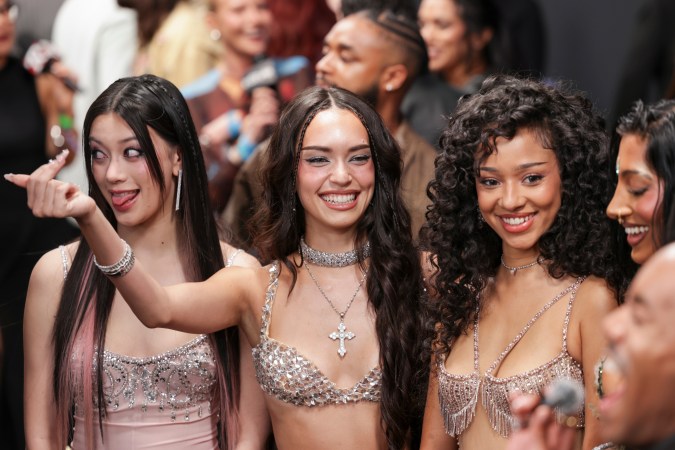
Daniela Avanzini of KATSEYE performs on Friday, Dec. 12, 2025, at Youtube Theater in Inglewood, Calif. (Photo by Andrew Park/Invision/AP) Credit: Associated Press

Daniela Avanzini is the latest Latina being asked to prove she’s Latina enough.
The KATSEYE member has recently been at the center of online debate, with critics questioning whether she’s only now leaning into her Venezuelan and Cuban roots as a branding move, something that feels convenient at a time when Latinidad is more visible and embraced than ever.
The discourse only intensified after her father, Rafael Avanzini, made controversial comments suggesting the group should continue with the show despite Manon Bannerman’s health-related hiatus. But at its core, the criticism seems to be that Daniela didn’t publicly embrace her Latina identity before —that she benefitted from her privilege as a white Latina to blend in—and is now highlighting her heritage more visibly to appeal to a broader, more global audience.
But Daniela’s supporters argue the opposite: that she’s always identified as an American-born Latina who has not only acknowledged her heritage in the past but has also demonstrated — through live streams, interviews, and even her singing — that she is bilingual and proud of her background. Many believe the backlash feels less like accountability and more like policing.
And that’s really what this conversation is about.
Over the past decade, as identity politics has become more visible in mainstream media and public figures have been held more accountable for their words and actions, one thing that hasn’t exactly served us as people of color is the policing of identity — especially within Latine communities.
Many of us who were born or raised in the U.S. have been told at some point or another that we’re not “Latina or Latino enough,” whether it’s because we don’t speak Spanish or aren’t fluent, because of our upbringing, or because of how we are racially perceived. It’s something Latines in the States have always had to face. But in recent years, it has evolved into something more rigid in my view: a policing of who gets to identify as Latine and who gets to be accepted by the community.
And while this is often framed as a way to hold people accountable, it can sometimes do more harm than good. KATSEYE is a K-pop-adjacent all-girls group with members from diverse backgrounds and ethnicities. As a result, fans are quick to investigate — and police — authenticity. But the real question becomes: who gets to define identity and by whose standards?

If we look at the receipts, Daniela has previously shared that she is a Latina from Atlanta with Venezuelan and Cuban parents. Is it really fair to assume she didn’t identify that way before? And even if she didn’t, is there room for people to reconnect with and embrace their heritage later in life?
As someone who has experienced both sides of these debates—growing up being told I wasn’t Dominican enough for not being fully fluent in Spanish, for not spending every summer in the DR like many of my peers, or for being told I wasn’t Black enough to identify as Afro-Dominican—while also being someone who has called others out for only embracing Latinidad when it’s convenient or profitable, I think it’s important to understand where much of the criticism around identity policing stems from before turning this into yet another internet argument about why policing who is “Latine enough” needs to end.
Without that context, the argument risks falling flat.
While the longstanding gatekeeping around Latinidad isn’t new—it’s simply resurfacing with a new celebrity, with Daniela becoming the latest target of a much older conversation—it’s also worth unpacking the tension between diaspora identity and performance. First, Daniela is part of a global pop group designed for cross-cultural appeal, and she also has the privilege of being able to present as white in a country rooted in white supremacy. While it’s unfortunate that she has to bear the weight of a diaspora’s pain, this debate isn’t really just about her. It’s about who gets to claim Latinidad. People of color—especially those living in the U.S.—are constantly made to prove our loyalty to our communities and demonstrate our connection to our culture in ways that white Americans are rarely, if ever, required to.
This conversation reveals something deeper—it’s about history, power, and how identity is policed in the U.S. Whiteness in this country isn’t treated as an “ethnicity”; it’s treated as the default. In the U.S., “white” has functioned less like a culture and more like a baseline identity. White Americans aren’t usually asked, Are you Irish enough? Italian enough? Their Americanness is assumed—not questioned.
That’s because whiteness has been positioned as the norm. Everyone else becomes “something else”—something that needs to be explained or proven. Communities of color, on the other hand, have historically been denied belonging. For Black, Latine, Asian, and Indigenous communities, identity has been shaped under systems that questioned their legitimacy—from slavery and segregation to immigration restrictions, genocide, cultural erasure, and pressure to assimilate into white American culture.
Over time, identity for people of color has become something we’ve had to not only defend and prove, but also preserve. In the U.S., opportunities for representation—especially in media, music, film, TV, and politics—are still limited. As a result, when someone is positioned to represent a group, it can feel high-stakes.
There’s a valid concern: does this person accurately reflect the community, or represent it in the best light? The problem is that this creates pressure for individuals to be perfect embodiments of an entire culture. Meanwhile, white Americans don’t experience this in the same way. Representation of whiteness is so abundant and normalized that no single white person is expected to represent all white people.
When it comes to Latinidad, race is a central factor. Colorism and proximity to whiteness within our communities still shape how we are perceived and treated in the world. There’s a common misconception that Black and brown Latines who react with suspicion when white or white-presenting Latines suddenly choose to publicly claim their heritage are acting out of jealousy or engaging in random gatekeeping.
But the truth is that this reaction is often rooted in lived patterns within Latinidad—patterns shaped by race, power, and who gets to be visible. Latinidad has its own racial hierarchy that mirrors whiteness. Within Latine communities, there has long been a system in which lighter skin, straighter hair, and Eurocentric features are often rewarded, while darker skin, Afro-textured hair, and Indigenous or African features are marginalized or erased.
This is the legacy of colonialism and colorism, where proximity to whiteness equals access—and that reality has not entirely disappeared. Despite whatever progress we’ve made as a diaspora, this dynamic still very much exists today.
So when a white or light-skinned Latine person suddenly emphasizes their identity, it doesn’t land in a vacuum. It’s not just about how that individual identifies—it lands within a system where they’ve likely already benefited from not being visibly “other,” while many darker-skinned Latines never had the option to “opt out.”
For brown and Black Latines, our identity is often visible whether we claim it or not. We don’t have the privilege of blending in with whiteness. We experience racism from the outside and colorism within our own communities, which means we can’t move through the world as “just white” or selectively reveal our Latinidad when it’s convenient.
So when someone has the ability to opt in and out, it raises a real question: Where were you when Latines were being targeted or marginalized? Where were you when our communities were suffering at the hands of systems of power?
Sudden pride from a white or light-skinned Latine public figure—whether a music artist or a politician—can feel like selective participation, especially if that person appeared to downplay their heritage in the past and only embraces it when it’s trending, marketable, or culturally valuable. It can come across as cultural opportunism—not necessarily because it is, but because of how these patterns have historically played out.
At the heart of much of this criticism is a real question: Are you benefiting from something we’re still being penalized for? The tension is about inequity. At its core, the reaction is less about “you’re not Latine,” and more about “you haven’t had to carry this identity the way I have.” That concern is real, even if it doesn’t apply in every case. And it’s worth noting that this tension isn’t experienced equally, especially for Black Latines, whose exclusion within and beyond our communities has been more persistent and consequential.
For darker-skinned Latines, Daniela’s more public embrace of her Latinidad can feel less like a personal evolution and more like a familiar pattern—one in which, suddenly, being Latina becomes valuable, at a time when Spanish-language music is global and profitable, and Latinidad is trending in pop culture.
With that said, just because Daniela has recently been embracing more of her Latinidad publicly does not mean she’s being inauthentic. It doesn’t mean she isn’t Latina enough, and it doesn’t mean people aren’t allowed to grow into their identity—especially if they weren’t raised in it.
What it does mean, however, is that how she chooses to express her identity is being read through a history she didn’t create but still benefits from as a white Latina. Historically, Latinidad becomes more visible, celebrated, and rewarded when it’s embodied by someone in closer proximity to whiteness—and Daniela is sitting right at that intersection.
So how do we hold that truth while still making room for people? Using Daniela as a case study, what we’re really asking is how a community can protect itself without becoming rigid or quick to cancel.
Giving grace and the benefit of the doubt doesn’t mean ignoring the history or power dynamics that are still very much at play. It means pausing before assigning intent and resisting the urge to make assumptions until you know the full story. Instead of quickly accusing Daniela of embracing her Latinidad because it’s trendy, we might ask: what has her relationship to her identity looked like before this moment?
I think if Latinidad is something we want our people to embrace, we have to make space for how and when they arrive at it — not just how convincingly they perform it once they do. I’m not suggesting that the goal is to lower the bar for accountability, but rather to stop confusing accountability with exclusion. Because if we’re serious about building community, then our responsibility isn’t just to protect culture—it’s to make sure there’s still room within it for our people to come home to.


