Why Young Voters Are Rallying Behind Candidates Like Darializa Avila Chevalier
A new political generation is emerging—and Darializa Avila Chevalier is part of it

Democratic congressional candidate Darializa Avila Chevalier speaks during a Get Out The Vote rally ahead of New York's primary election, Thursday, June 18, 2026, in the Brooklyn borough of New York. (AP Photo/Ryan Murphy) Credit: Associated Press

Many younger voters—particularly younger Latine and Black voters—came of age amid overlapping crises: the Great Recession, rising student debt, a worsening housing market, the COVID-19 pandemic, inflation, mass layoffs, immigration crackdowns, and ongoing racial justice struggles. For many millennials and Gen Z voters, the promise that hard work leads to stability and opportunity no longer feels guaranteed.
As housing, childcare, groceries, and other necessities become increasingly unaffordable, many young adults are delaying milestones such as homeownership, marriage, and parenthood. The result is a growing frustration with institutions and a deepening distrust of traditional politics.
There’s a reason so many Americans—beyond just New Yorkers—became familiar with and supported Mayor Zohran Mamdani during his campaign. He approached campaigning differently than many traditional politicians, focusing heavily on affordability and quality-of-life concerns. As a democratic socialist, much like Congresswoman Alexandria Ocasio-Cortez, Mamdani often framed political change as something driven by collective action rather than individual leadership.
Now, a new candidate—a Latina—is becoming part of that generational shift.
Darializa Avila Chevalier, a democratic socialist and a Zohran Mamdani-endorsed candidate, is not only challenging incumbent Adriano Espaillat in the state’s 13th Congressional District, but also offering something that extends beyond representation.
A Dominican American who has lived in the 13th District herself, Chevalier understands the realities her community is living through—including displacement driven by a lack of affordability—and believes it is the government’s responsibility to address them.
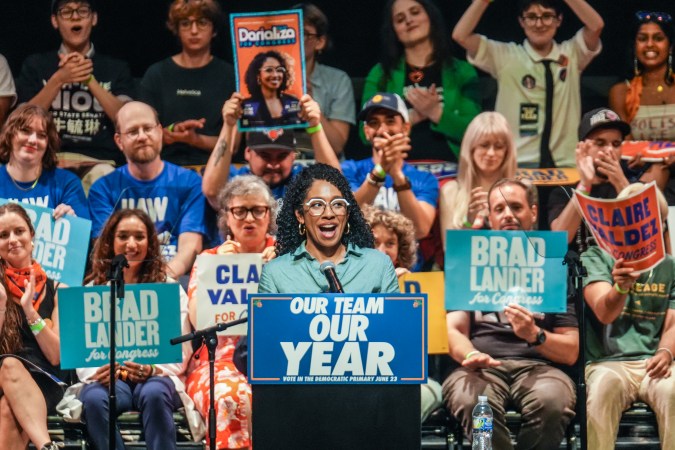
“I think representation needs to be one that is reflective, not only of people’s identities but of the things that they are fighting for,” she tells HipLatina. “It doesn’t help any of us to have someone in office who might look like us, but yet will consistently enact policies that harm us. We need representation that understands that the fight has to be one that will better the lives of the people who live here.”
One issue Chevalier frequently raises is the growing number of Dominicans leaving New York City after being priced out of neighborhoods they have long called home. For decades, Washington Heights and Inwood were considered what many referred to as “Little Dominican Republic,” representing one of the country’s largest Dominican neighborhoods. A 2025 Study from the Center for Latin American, Caribbean, and Latino Studies at CUNY found that New York City’s Dominican population declined by 13% between 2021 and 2024. Many are leaving because staying in NYC no longer feels economically possible.
Chevalier is also fighting for what she refers to as dignified housing.
“It’s about making sure our children can afford to have good childhoods, dignified childhoods with good education,” she says. “To say that you love your community, that is something that you have to show and prove every single time you make a policy choice.”
As a result, Chevalier understands the lack of motivation voters in her community have been feeling about politics.
“I get it. I understand why so many of us have felt so disillusioned by a politics that has told us that the only thing we can do is vote against something even scarier and not present to us a vision for something that we actually want to vote for,” she says. “And I think we have an opportunity here to build the government that we deserve, and we need to really grab onto that.”
She continues, “We are in a moment where we can either succumb to the fascism that we’re facing, or we can fight back and build something much better, something that will actually lead towards having dignified lives for every single person in the city and across the country.”
Chevalier, who served as an organizing lead for Mamdani’s mayoral campaign in her district and has lived in New York City for 14 years, has herself often felt abandoned by establishment politics. Similar to Mamdani’s approach, rather than speaking in abstract ideological terms, she has focused on the issues shaping the daily life in her district, from rising rents and childcare costs to access to affordable healthcare and groceries.
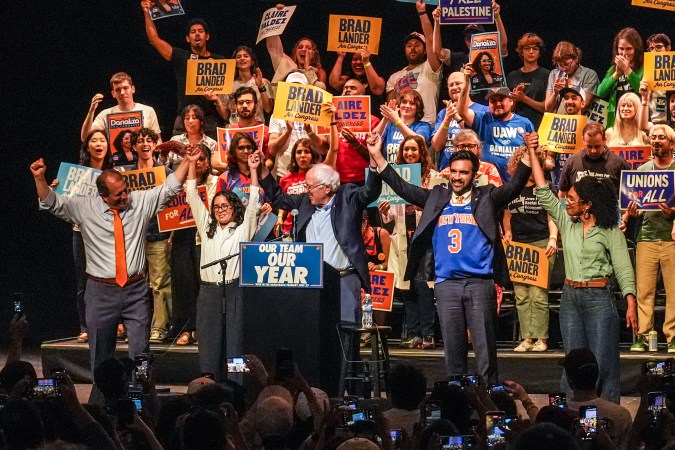
For many Americans, not just Latines, life has become increasingly unaffordable. Young voters, especially, are feeling this hard, which is why a lot of the disillusionment they have with politics isn’t just solely directed at Republicans. Many younger voters have also become frustrated with the Democratic Party. The criticism is often that Democrats haven’t delivered sufficiently on the issues that most directly affect their daily lives.
Mamdani’s campaign reflects a growing interest among some younger voters in candidates who speak directly to those concerns. Rather than relying on traditional political messaging, his campaign centered issues that incredibly resonate with voters looking for tangible solutions rather than broad promises.
In many Latine communities, the S word—socialism—is often met with a lot of misconceptions about what that means and what it could look like here in the States. But young voters are starting to see that democratic socialism is not necessarily about replacing capitalism. It’s understanding that things like healthcare should be accessible. Housing should be affordable and a basic human right. That childcare should be free and accessible to all working parents, and that the government should play a strong role in reducing economic inequality.
“For far too long, we’ve had a Democratic party that claimed to be fighting for working people and yet our lives got more and more unaffordable, and yet they could not present a vision for how to make our lives better,” Chevalier says. “I think the most common misconceptions I hear are the idea that socialists just don’t want to work. It’s completely counter to the notion.”
She believes that at its core, socialism is actually the idea that there is purpose and dignity in work. That work actually gives our lives meaning.
Or, in her words, “It’s not that folks want to stop working. It’s that folks want to be able to work in a way that gives their lives dignity and purpose, and what we’re seeing right now is a system that is deeply exploitative, where people who own make more money than the people who work. We shouldn’t have a world where, when working people are struggling, they are left without the resources they need to survive.”
Regarding what has contributed to the political divide in the states today and to the collective fear of socialism that has taken over our politics for decades, Chevalier believes it began with the neoliberal movement of the 1970s. At its core, neoliberalism argues that private markets are more efficient than government and should provide many of the services that were previously provided by the state.
“The reason that started to happen is because we have a society, a system, an economic system, that prioritizes profit over human lives—over people,” she says. “And so there was an inundation of rhetoric that sought to tell everybody in our society that public goods are bad and the private industry is what’s going to help us have a more fruitful economy and a more robust economy. And that’s what we’ve seen because of this neoliberal politics of divestments from public goods, those schools, public infrastructure, public housing, roads—all those things that are getting defunded.”
With the New York primaries taking place on Tuesday, June 23, which decide the competitors ahead of the midterm elections in November, Chevalier wants to lead with the values.
“I think we get lost in these labels, these terms, but if you tell anybody in our community, ‘Hey, I think healthcare is a human right, I think everyone should be able to afford a dignified place to live, I think anybody who works should be able to also enjoy the product of that work that they’ve done, they’d agree,’” she says. “But we have had this inundation of purposeful misrepresentation as to what these terms actually mean that I think it’s just time we start talking about the values and then saying, ’And that is why I’m a Democratic socialist.’”
All in all, Chevalier’s campaign ultimately speaks to a larger reckoning in American politics today. As affordability pressures reshape cities like New York, younger voters are increasingly gravitating towards candidates who frame politics as a tool for real change rather than symbolic representation. The shift suggests that her candidacy is less an exception and more a signal of where the next generation of politics might finally be heading.


