It’s 2026— & We’re Still Debating Whether Darializa Avila Chevalier Is “Dominican Enough”
What the backlash reveals about anti-Blackness in Latine communities

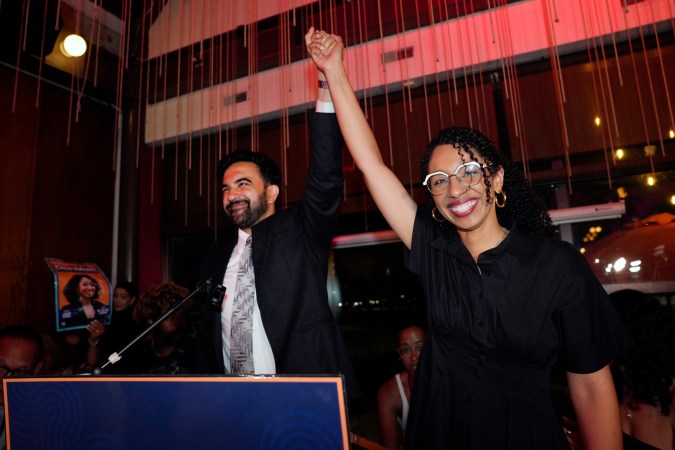
Democratic congressional candidate Darializa Avila Chevalier speaks to her supporters during an election night watch party Tuesday, June 23, 2026, in New York. (AP Photo/Seth Wenig) Credit: Associated Press

Tuesday night, Darializa Avila Chevalier made history, defeating incumbent Adriano Espaillat to become the Democratic nominee for New York’s 13th Congressional District. But before the votes were counted, another conversation about Avila Chevalier was picking up online. Instead of debating her policies or vision for the district, some critics—particularly Dominicans—chose to focus on her identity, with her last name becoming a source of speculation.
All of a sudden, despite the fact that Avila Chevalier has mentioned numerous times that she’s Dominican American and that both her parents are Dominican, her identity has continued to be questioned. “Haitian” was used as an insult and an accusation in social media posts and comments, with many Dominican nationalists on social media debating whether she is really “Dominican” at all.
Sadly, the attacks on Avila Chevalier revealed nothing new about our communities. Instead, they merely exposed the longstanding anti-Haitian sentiments that continue to exist within the Dominican community and the anti-Blackness that continues to exist throughout Latine communities more broadly.
The fact that a candidate’s ancestry became a larger point of discussion than her actual policies raises uncomfortable questions. For one, who gets to be considered Dominican? How is it that we’re living in 2026 and Haitian identities are still being weaponized as if being Haitian is something shameful? And why do conversations about Blackness continue to make so many people in Latine communities uncomfortable?
The truth is that the vicious backlash against Avila Chevalier was never just about her. It revealed something bigger and deeply rooted, which is the tensions around race, identity, and belonging that many Dominicans have long known exist, even if our own communities are still reluctant to confront them. In terms of what has continued to contribute to the anti-Haitian and anti-Black sentiments that persist in Dominican communities, Dr. Saudi Garcia, a Dominican American scholar, organizational leader, movement builder, researcher, and Executive Director of In Cultured Company, believes there has been a systemic effort from inside the Dominican state to continue to portray Haitians as the enemy through both the education system and the media.
Garcia says anti-Haitian wasn’t inevitable— it was cultivated. She explains that beginning in the late 19th century, Dominican nationalist writers began reframing the Unification period (1822-1844) as ‘La Dominancion Haitiana,’ reducing a far more complex history into a narrative that cast Haitians as the nation’s enemy. Over time, she says, that interpretation became embedded in Dominican schools and state institutions.
“With [dictator Rafael Leonidas] Trujillo’s rule of over 30 years, you see that vantage point become part of the state’s education system and norms in a more rigorous way,” Garcia says. Trujillo’s writers in the 20th century, people like Manuel Arturo Peña Batle, Ramón Marrero Aristy, and Joaquín Balaguer, wrote to erase Black political agency and historical solidarity. They are the ones who wrote the textbooks Dominicans study with.”
As a result, Garcia explains, much of Dominican identity has been shaped as the opposite of Haitian identity.
“If Haitians are Black (as they themselves chose to be identified in the 1804 constitution), then Dominicans are non-Black, she says. “Not European white, but not Black. Instead, something in the middle that is an ambiguous mezcla and that now is just called ‘Dominican.’”
What Garcia is unveiling is actually something many scholars of Dominican identity, including Ginetta E. B. Candelario, the author of “Black behind the ears,” have written about. The idea that if Haitian identity has historically been associated with Blackness, and Dominican identity has historically been defined in opposition to Haiti, then Blackness itself can become something to distance oneself from.
For centuries, Dominican national identity has been constructed not just around what Dominicans are but what Dominicans are not. Because Dominicans equate being Haitian with being Black, they often see themselves as mixed, indio, Hispanic, or simply “Dominican.” Even if they don’t necessarily identify as white, many still don’t identify as Black, even if racially they do in fact fall under that category. This is where “Dominican” itself almost becomes the racial category. The problem is that race doesn’t just suddenly disappear when we replace it with nationality, which is why a lot of Dominican Americans who are raised in the states—particularly millennials and Gen-Zers—often do identify as Black.
“I think these conversations can get very emotional without a theoretical framework and historical context,” Garcia adds. “For Dominicans who have been raised inside of Trujillo’s narrative and for the generations after that experienced the rise of nationalism inside the state, it can feel like we are attacking the DR’s right to exist as a nation.”
Garcia argues that because nationalist narratives became deeply embedded in Dominican politics and culture, many people interpret conversations about anti-Blackness or anti-Haitianism as attacks on the country itself.
But Garcia further explains that the attack Dominican progressives are making is not at the Dominican Republic’s right to exist as a nation but as an attack against “the elite highjacking of a national project that was meant to be a multi-racial republic.”
When Blackness becomes externalized and associated with Haiti and Haitians, this often comes with contradictions within Dominican identity itself. Meaning a Dominican could have dark skin, afro-textured hair, and other phenotypical evidence of being Black or of African ancestry, and still find themselves rejecting the Black label if they grew up indoctrinated into believing that Blackness is what separates them from Haitian identity. It’s that deep. The issue is whether they recognize it or not, this actually harms Black Dominicans themselves by making them invisible while also reinforcing colorism, anti-Blackness, and anti-Haitian sentiments.
How does this all relate to Avila Chevalier? Because when Dominicans chose to scrutinize her identity versus her policies, what they were essentially doing was calling into question her authenticity. Her Dominican identity suddenly became something that people believed they actually had the right to question and evaluate.
What many Dominicans associate with pride and patriotism, Garcia argues, is actually a form of nationalism that ultimately harms not just Haitians but Dominicans themselves, especially those of African descent.
“Nationalism is a political movement that relies on cultural and political exclusion,” she explains. “Nationalism says that the government exists to protect culture and the interests of the nation. So nationalism is always defensive and needs an external attacker or ‘enemy,’ that it must defend against. That enemy is often imagined, and when there isn’t an organic ‘other,’ a nationalist government will invent one from within the existing population.”
Garcia believes that Avila Chevalier became a target for Dominican nationalists who tried to claim she isn’t “Dominican enough,” because she doesn’t fit the ideological, religious, or language profile that nationalism expects.
One of the biggest things we can take away from the attacks against Avila Chevalier is to stop treating Blackness as something separate from Dominican identity. This idea that Blackness is something that exists outside of the Dominican community is exactly what has continued to uphold these anti-Haitian sentiments that sadly still exist in our communities.
And this doesn’t just apply to Dominicans but to all Latine communities. When we refuse to acknowledge Blackness within our own communities, we make it so much easier to stigmatize Haitians and other folks that are part of the Black diaspora—including our own. Latines love to celebrate our African roots through food and music while distancing themselves from Black people themselves.
Garcia finds the attacks against Avila Chevalier very reminiscent of the political propaganda directed at Jose Francisco Peña Gomez, a Dominican politician on the island who served as mayor of Santo Domingo and ran for president in the 90s. Despite the fact that he was born in the Dominican Republic, because his parents were Haitian, he was often accused of not being Dominican enough.
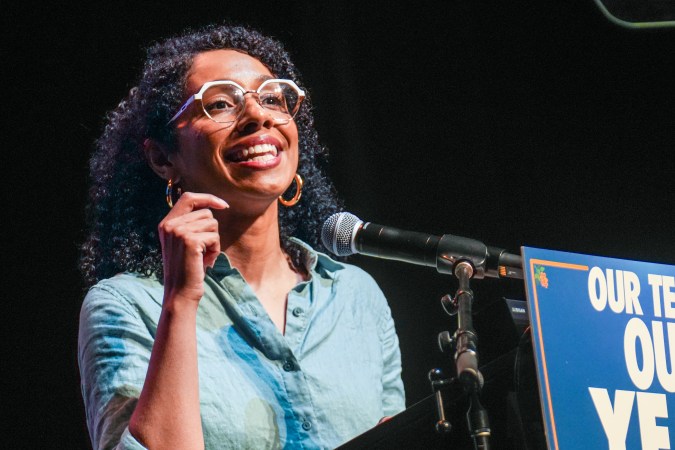
“[This episode] revealed that we have a ton of work to do in our communities to make sure people do not fall prey to disinformation and propaganda campaigns,” Dr. Garcia says. “[Avila Chevalier’s] victory and the way that diaspora Dominicans of all generations (but especially Gen Z and Millennials) vocally supported her means that extreme Dominican nationalism suffered a defeat. The old tactics and playbook of using anti-Haitianism have run their course. Now, we need to make sure that this does not persist in our community.”
If this election revealed anything, it’s that anti-Haitian and anti-Black sentiments have not disappeared from our communities. But it also showed that these old tactics may no longer hold the same power they once did. The question was never whether Darializa Avila Chevalier was Dominican enough. The question is why, in 2026, so many people still believe that’s a question worth asking.


