Julia Alvarez on Aging, Mortality, & Why She’ll Never Stop Writing
The author reflects on legacy, getting older, and why writing remains the way she makes sense of the world

Photo credit: Knopf Credit: Courtesy

Dominican writer Julia Alvarez has been telling stories for more than four decades. Her first book, Homecoming, a poetry collection, was followed by her groundbreaking debut novel, How the García Girls Lost Their Accents (1991)—a book that made many Dominican Americans feel seen for the first time. She later established her place in literary history with In the Time of the Butterflies, a historical fiction about the lives of the four Mirabal sisters who fought against the dictatorship of Rafael Trujillo in the Dominican Republic.
As one of the first Dominican writers to gain widespread recognition in the United States, Alvarez became a defining voice for the Dominican diaspora, helping pave the way for a new generation of acclaimed authors. Writers like Angie Cruz, Elizabeth Acevedo, and Cleyvis Natera followed in her footsteps. For many Dominicans, Alvarez did something revolutionary by putting Dominican stories at the center of American literature.
Following the release of her new poetry collection, Visitations, Alvarez reflects on her career and legacy, the realities of aging, and how both shaped her latest work. The result is what may be her most vulnerable work to date.
“Four decades of my life, what the publishers wanted was novels, and I was working on those, but in between and sometimes in the middle of that, I would always return to my rock bottom, which was poetry,” Alvarez tells HipLatina. “It was my first love, and I still think of poetry as the purest form of expression. So, to keep returning to it is like to keep reminding myself of the best that language can be.”
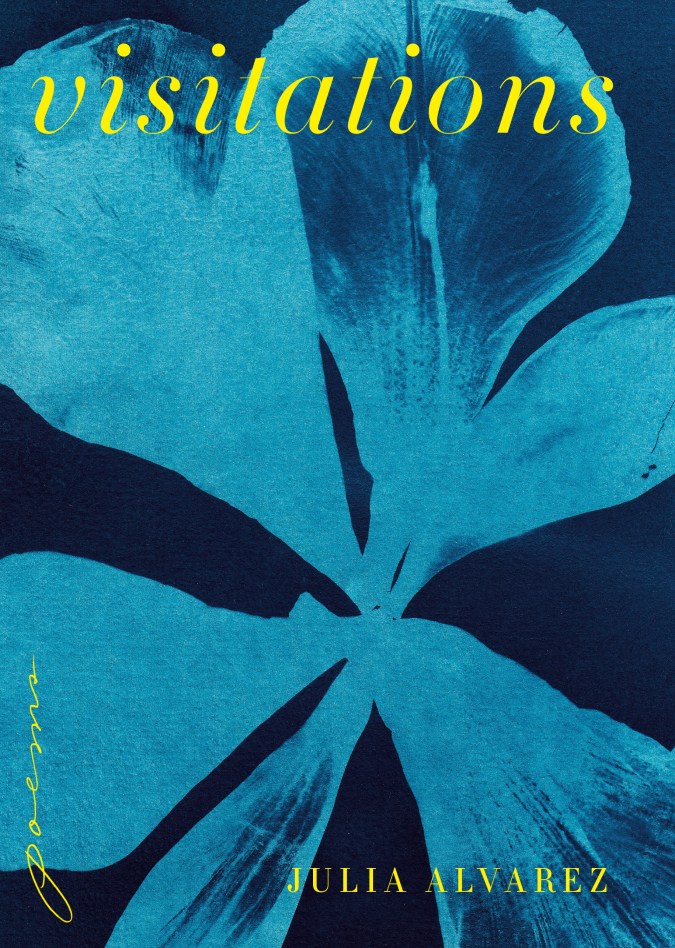
Alvarez admits that some of the poems featured in the book were written years ago when she was a much younger woman. Others were written more recently. One of the biggest themes throughout the collection is getting older.
“I encountered racism, ethnic prejudice, repulsion of the immigrant, the other, the alien—all those –isms that erase people now in this stage of life. I’m now in the –ism of ageism,” she says. “So often, older people are not the main characters in any story. They’re usually in the background dispensing advice or the witch that’s getting in the way of the protagonist.”
Alvarez says part of the inspiration behind Visitations was understanding the stage of life she’s currently in at 76.
“If we’re lucky, we’re all going to get old. So it’s a landscape that is worth exploring,” she says. “What are the stories of this stage of my life? What is it when we’re very much at that ending of things rather than the crescendo and the excitement? What does it mean to be so close to the dead we have lost? To have more people dead that we love than alive? What does that mean?”
These themes emerge in poems like “The Red Bathrobe,” where Alvarez explores what it means to look over your shoulder as people with more youth, power, or beauty enter the scene.
The poem begins with:
We were talking tonight about who we are now that we’ve put away the lab coats, the lecture notes, taken down the framed picture of Sisyphus rolling his stone uphill, the degrees broadcasting our expertise, turned in the keys to the van with the logo. Now that we’ve gone back to being the people whose shoulders other people look over at parties, checking out who of more beauty, youth, self-importance and power is arriving.
“That invisibility, I think, is important to acknowledge and to name and to story about,” she adds. “Because I feel like there’s not a lot of story around that specifically.”
Despite helping pave the way for a generation of Dominican writers — and being honored at the Dominican Writers Summit 2026 — Alvarez admits she tries not to dwell on her legacy.
“I really don’t think about it. If I thought about it, I would lose my focus, actually,” she says. “When you’re writing, you’re in the service of the story and the characters. I can’t be looking at my audience or thinking about anybody, whether positive or negative, and how they might react. You are just true to the story. Later, you can make decisions about what to release or how to revise it. But not in the moment.”
But when she does take a moment to look back, she returns to what first inspired her to write: not seeing stories that reflected her own experience.
“When I started writing, there was that gap in the shelf. I couldn’t see myself. There were immigrant stories already out there, but they were all by men. Many of them were Mexican Americans, and all of a sudden it was just like we’re all under the same umbrella, but it’s not the same kind of family, history, or ways of looking at things,” she says. “I needed to understand what is happening to me, my sisters, and I go into story not because I have answers but because I have questions.”
She also recognizes what a privilege it has been to build a career as a Dominican American writer—and still be doing the work at 76.
She reflects “I have immense gratitude because I mean, how lucky is it to be able to do what is your passion to do in this world and get paid for it?”


