Dominican Women Writers Are Leading a Literary Movement
Wrtiers are redefining what Dominican storytelling can look like altogether

Photo by Claudio Abreu. Credit: Courtesy

Dominican storytelling has been making its way into the mainstream in recent years, but when you take a closer look at the literary landscape—particularly within the diaspora—it’s Dominican women who have consistently shaped some of the most nuanced and culturally defining narratives of our time. From trailblazers like Julia Alvarez, known for writing classics like How the Garcia Girls Lost Their Accents and In the Time of the Butterflies, to contemporary voices such as Elizabeth Acevedo, Dominican women writers have long explored the complexities of identity, migration, memory, race, womanhood, language, and belonging with a depth that has expanded not only Dominican literature but Latine literature as a whole. Their work has challenged stereotypes, preserved cultural memory, and offered intimate portraits of Dominican life both on the island and across the diaspora.
While Dominican literature has never belonged exclusively to women, it’s impossible to ignore how many of its most visible and celebrated voices today are, in fact, women. At a time when conversations around representation and authorship continue to evolve, Dominican women writers are not only telling their own stories—they are redefining what Dominican storytelling can look like altogether.
This year, Dominican Writers held their first conference since 2019 from May 1 to May 2 at John Jay College in New York City.
“Honestly, the pandemic changed everything for us, as it did for so many organizations,” Dominican Writers founder Angela Abreu says. “Once COVID arrived, everything went digital, our programming, our workshops that used to meet on Sundays in my apartment. A lot of people expected us to take the conference virtual, too, and I got asked about it more than once, but that never sat right with me. The conference has always been about being in the room together, and I wasn’t willing to compromise that.”
Abreu began exploring holding the conference at City College, also in New York City, where they had hosted events before, but found herself facing new obstacles due to policies that made it difficult for the general public to convene on campus.
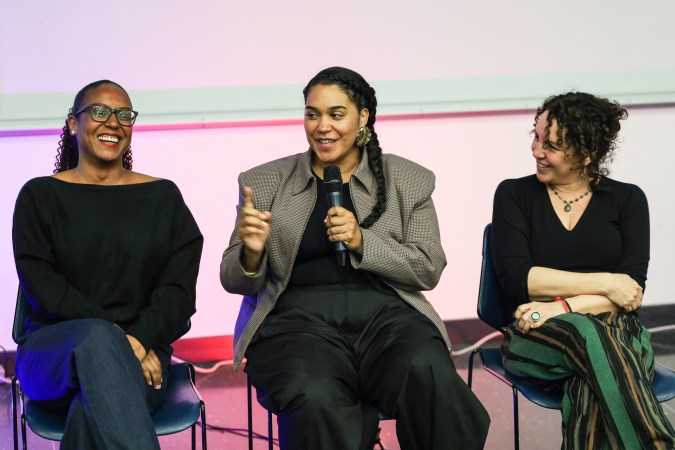
“Putting together a conference of this magnitude takes enormous resources, coordination, and the right moment. We had to be intentional. We didn’t want to just put on an event,” Abreu says. “We wanted to recreate the experience of 2019, something that would feel meaningful and lasting for every writer who walked through those doors.”
She continues, “With DWC 2026, we wanted to come back with something that truly honored where Dominican literature is right now, which is in such a powerful, exciting place. The goal was to give our community a room where they could see themselves, fully reflected, in the panelists, in the conversations, in the theme itself.”
The two-day conference featured panels and workshops, with panelists and moderators who were predominantly Dominican women authors. There was everything from discussions on how to break into the graphic novel movement and write middle-grade stories with purpose to poetry, children’s books, and modern romance. There were even a few dedicated specifically to Dominican women writers, such as the “Inheritance & Intuition: Writing Dominican Women” panel, which included authors Angie Cruz, Elizabeth Acevedo, Cleyvis Natera, and Natalie Guerrero, and a workshop called “Reclaiming La Madre: Writing the Dominican Woman Mother Wound” with Dariana M. Pichardo, LMSW, MPA.
“I think Dominican women have always been storytellers. We carry the history of our families, our communities, our migrations. What’s shifted is that we now have the language, the platforms, and crucially, the permission to put those stories on the page and call them literature,” Abreu says. “I also think there’s something about the urgency of our experience. Being Dominican, being a woman, being an immigrant, being Black, navigating all of that in a country that doesn’t always see you fully, that urgency demands expression. And Dominican women have answered that call loudly and beautifully.”
The theme of this year’s conference was “Reclaiming Our Palabras.” For Abreu, now was the perfect time to host an event highlighting the importance of Dominicans reclaiming our narrative and pushing back against the idea that our stories don’t belong in mainstream literature.
“We are living in a moment where our government is actively trying to erase us, pushing a narrative that we don’t contribute, that we don’t belong, that we are somehow less than. That is not just incorrect—it is a lie. We wanted this conference to be a direct response to it,” she says. “Language has always been a site of tension for us. At home, Spanish was valued. It was how we loved each other, how we told our stories, how we kept our culture alive. But the moment we stepped outside, society told us something different. To soften our accents, to leave certain words at the door, to believe that the language of our homes had no place in ‘serious’ literature.“
The conference was dedicated to Julia Alvarez, who recently released her latest book Vistations, a collection of poems drawn from all seasons of her life, from childhood to the years of silver.” There was a keynote by Alvarez with Cleyvis Natera, in which they discussed Alvarez’s legacy as a writer, how her work gave Dominican writers permission to see themselves in literature, and the importance of the literary inheritance that Dominican women carry.
“Julia Alvarez is, in many ways, the reason organizations like DWA exist. She proved to a generation of Dominican women that we could write our way into the canon, that our stories were not too small or too foreign for the literary world,” Abreu says. “Dedicating DWC 2026 to her felt like the right way to honor that legacy, to say to her and to everyone in that room: we know where this path started, and we’re grateful. And the timing felt especially right with Vistations coming out. To celebrate her newest work while also celebrating what she has meant to all of us, that felt like a full-circle moment.”
There has literally never been a better time for Dominican women writers to break into publishing, but as Abreu explains to me, “the gatekeeping is still very real.” It’s one of the many reasons she started Dominican Writers in the first place, and why she wanted to hold the conference in person—so aspiring writers could connect with resources and mentors.
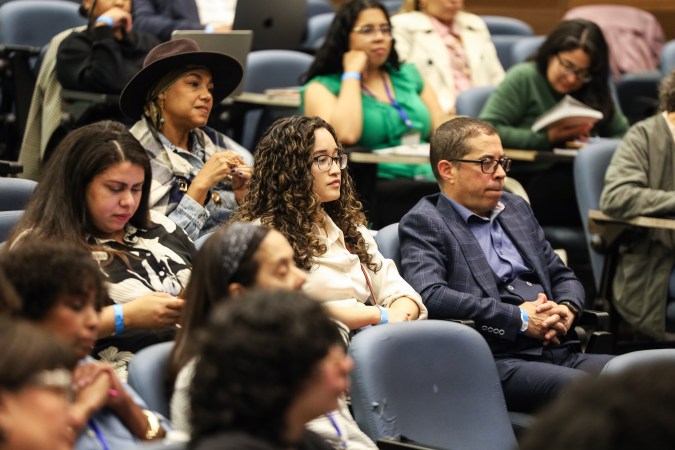
“There’s this persistent idea in traditional publishing that there is only room for one Dominican story, one Dominican voice at a time. Authors are still being told their work is “too niche,” or being asked to sand down the very things that make their writing distinctly ours—the Spanish, the cultural references, the complexity,” she explains. “At DWA, we try to meet writers where they are. That means education around the publishing process and community, so writers don’t feel like they’re navigating it alone, and increasingly supporting authors who choose to publish independently. Because the traditional route is not the only route, and we want our writers to know that.”
And while the gatekeeping Abreu speaks of is still very real, there’s also no denying that we’re living through an incredibly exciting moment for Dominican literature—especially for Dominican women writers. There are more opportunities, resources, workshops, conferences, and publishing spaces opening up for Dominican stories than ever before, and with that comes a growing demand for narratives that are nuanced, layered, and deeply human. At a time when conversations around who gets to tell stories continue to evolve, Dominican writers are proving that our stories are not niche—they are essential.
“My hope is that one day a Dominican author doesn’t have to fight to be taken seriously. That the stories we tell are received with the same weight and curiosity as any other literary tradition,” Abreu concludes.


