Bad Bunny’s Halftime Show Was About Unity — Not Outrage
Many wanted a protest moment, Bad Bunny gave something else

Bad Bunny performs during halftime of the NFL Super Bowl 60 football game between the New England Patriots and the Seattle Seahawks, Sunday, Feb. 8, 2026, in Santa Clara, Calif. (AP Photo/Matt Slocum) Credit: Associated Press

“Why didn’t he do LA MuDANZA?““Bad Bunny should’ve brought out a Latina performer instead of Lady Gaga.““Why didn’t he make a bigger statement against ICE or the current administration?““Where was the ‘F You’ moment to the racists?“
These are some of the reactions coming out of Bad Bunny’s Apple Music Super Bowl Halftime Show. And honestly, I get why people are asking them. But those questions are rooted in one assumption that seems to miss the mark: that the goal of the show was confrontation first.
I’m not here to dismiss criticism. I am saying that if we only judge the performance by what explosive moment didn’t happen, we miss what was actually built into it. This was not a halftime show designed around shock or retaliation. It was designed around cultural pride and unity. That is a different kind of statement, and it was a deliberate one.
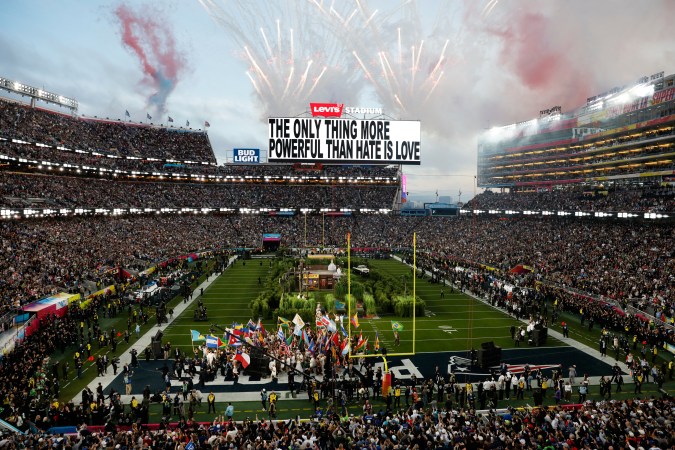
Many viewers were waiting for a direct political swing or a viral clapback moment. The resistance some people were looking for was present, just not packaged as anger. It showed up through language, imagery, musical choices, and who was centered on stage. That is not avoidance. That is strategy. And it wasn’t a sudden pivot. Just a week earlier at the Grammys, Bad Bunny urged people to remember that love is more powerful than hate — that same sentiment appearing on the jumbotron at Levi’s Stadium during his performance.
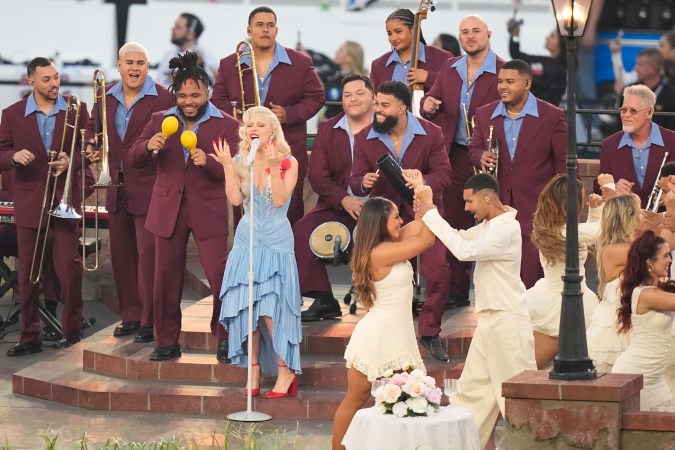
Let’s look at his guest choices, including Lady Gaga’s presence. If the expectation was that every collaboration had to function as a cultural alignment test, then yes, that moment will feel confusing. But look at it differently and it fits the show’s broader message. This wasn’t about gatekeeping culture or policing who gets to stand next to it. It was about showing that you can welcome collaborators into the space and still keep ownership of it. Being included is not the same as taking over. Lady Gaga stepped into the moment without centering herself — wearing a Dominican designer and Puerto Rican cultural symbolism — and adapted musically to the space with a salsa arrangement and pure, visible joy.
Right now, people tend to measure impact by how confrontational something feels. If it is not loud, people read it as soft. If not confrontational, it’s neutral. But is that not a narrow way to understand protest and power? Cultural joy can be disruptive. Pride can be disruptive. Refusing to translate yourself for comfort can be disruptive.
Speaking personally, as a Latina in media, I understand the instinct to want the hardest possible line drawn in moments like this. Many of us are tired. Many of us are angry. We deal with trauma, bias, and macro- and microaggressions, and the urge to answer that with visible anger is real. But after more than a decade in this industry, I’ve learned that the messages that stick aren’t always the loudest ones. People hear you differently when you are not only reacting, but directing the narrative.
It also matters how Latine communities are shown to mass audiences. Our people, especially now more than ever, are frequently shown through crisis imagery — raids, detention, violence, struggle. Those realities are important to report, but they are not the only truth of who we are. This performance put celebration, artistry, and excellence on the same global screen. That kind of visibility has an impact, too.
It is worth noting that the performance was educational without being a lecture. Viewers were learning, even if they did not realize it, through the sounds, visuals, and traditions referenced on stage. It even closed with a pointed reminder that America is a continent, not a country. These are the quiet but necessary corrections to how Latine culture is often flattened or misunderstood at scale.
If the main takeaway is which song didn’t get performed or which guest should have appeared, then the larger framework gets overlooked. A better question is what the show chose to center, and why.
Not every historic stage moment needs a punch thrown to be meaningful. Some are about planting a flag clearly and confidently. That is what this performance did.


