In Their Kitchens, Every Meal Is a Way Back Home
Meet two first-generation Mexican-American creators bringing neighbors together, one dish at a time

Credit: Aksa Lima | Courtesy

A particular kind of magic happens when the smell of chilies, cinnamon, and pineapple drifts through an apartment. For Fabrizio Villalpando, it’s the smell of childhood—and the scent he’s carrying next door to celebrate his vecinos.
In Los Angeles, Jon Dillanes—better known online as Hrna Eatz—is doing the same: cooking a Latine-culture-inspired meal and bringing it to next-door friends, the perfect excuse to knock and spend time together.
Both are first-generation Mexican-American creators whose work returns to the same idea: food is an excuse to gather people around a table and connect.
Fabrizio’s Long Road to the Kitchen
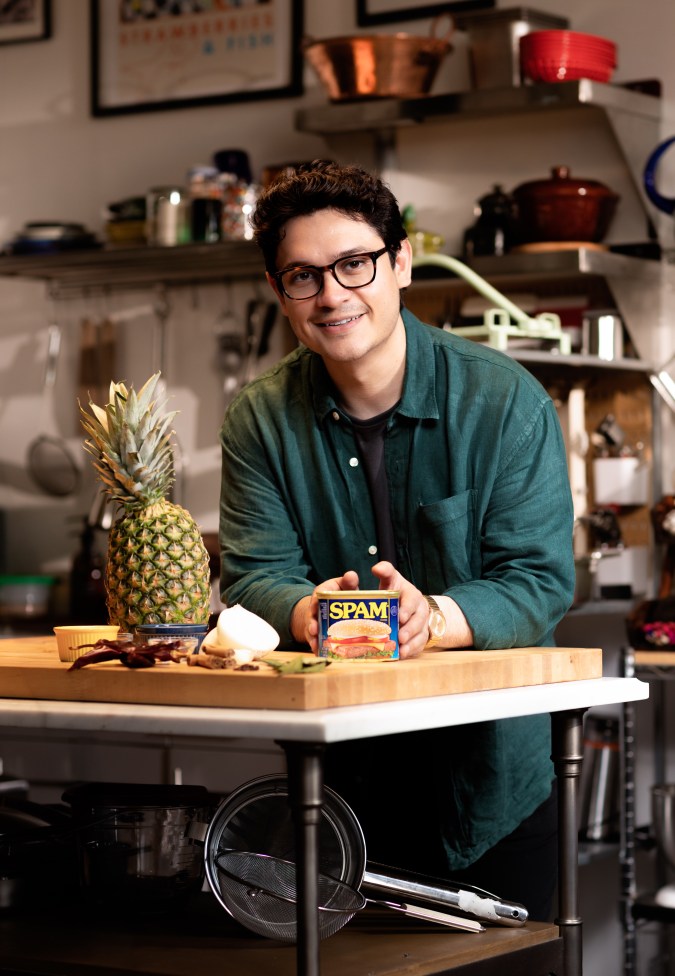
Fabrizio is a professional home cook based in Brooklyn. He’ll be the first to tell you the job title still makes him smile. “I feel like it’s probably one of the best jobs in the world,” he says.
He spends his days making his favorite foods, sharing recipes with his digital audience, and inviting brave followers to cook along. “Sometimes I get pretty lucky,” he says.
The road there was long. Fabrizio started washing dishes at fourteen at a small mom-and-pop restaurant in the Oregon town where he grew up. “When you’re working in a restaurant, you kind of get rewarded with eating a lot of food, because you’re just in the kitchen all the time.”
He kept at it for nearly a decade, eventually moving into high-end restaurants in Los Angeles. Watching chefs work planted something in him: cooking was cool, an art form worth pursuing. When the pandemic hit, he set out to teach himself, beginning with French classics, Julia Child, and Italian technique before his curiosity pulled him closer to home.
Jon’s Learning at His Mother’s Side
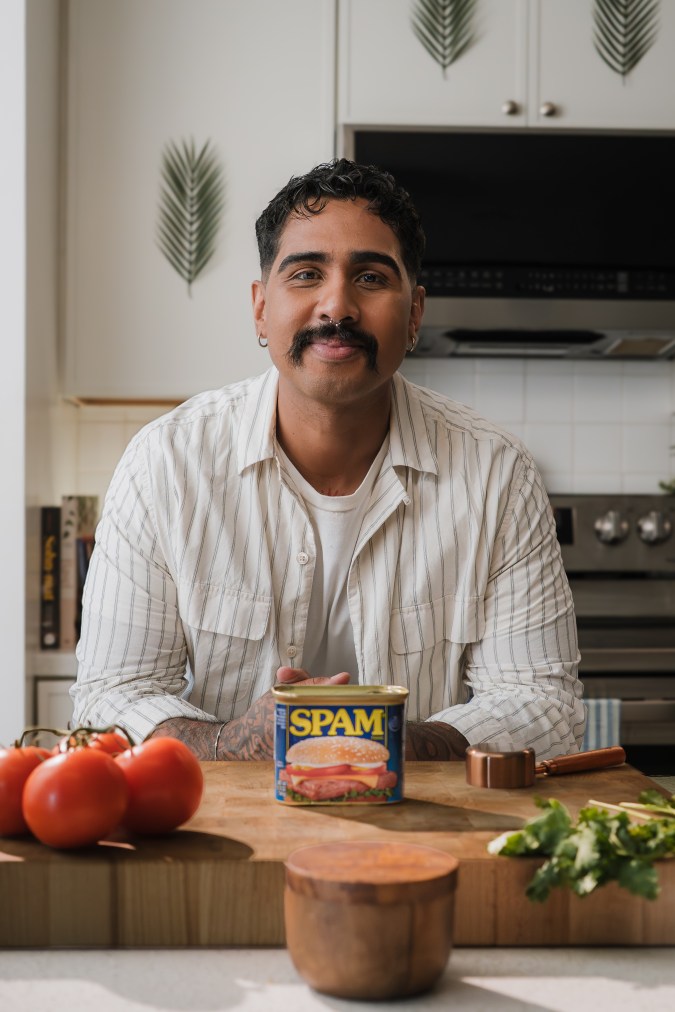
For Jon, the spark came earlier. “I first gained my curiosity for cooking from my mom,” he says. “I come from a family where everyone knows how to cook. Like you’re just born knowing how to cook,” he jokes. As a little kid, he’d hover in the kitchen, waiting for a way in. “I would just stand around in the kitchen, just watching, just waiting. Like, what can I help with?” he recalls.
Slowly, his jobs got bigger, from cracking eggs to running the hand mixer in fifth or sixth grade. “I thought it was like the biggest moment of my life,” he laughs. Cracking eggs, he’s quick to point out, was no small task either: not a speck of yolk in the whites, or the meringue won’t puff. “I was putting in my work. I was earning those.”
A first-generation Mexican-American born and raised in Northern California and now in LA, Jon grew up with his mother, who’s from Guerrero, cooking the traditional recipes of her home. For a long stretch, it was just the two of them—except when people came over. “I love the energy it brought into your home,” he says. “After everyone left, you just feel super energized.” That feeling became the seed of everything. “That’s really where my love for cooking spawns from. It’s like an active service for the ones you love.”
Cooking Their Way Back to Their Roots
Fabrizio grew up in a Mexican household in a small northwestern town in the late ’90s and early 2000s, a first-generation Mexican-American kid living in two worlds at once. “At home, it was one culture. And then you step out the door, and it’s something completely different,” he reflects.
As a child, some traditions puzzled him: why press tortillas by hand when store-bought ones existed? Growing up—and many trips to Mexico—took time to understand. Food became his method of exploration. “As I grew confident in my cooking, I grew curious in my culture and in my roots. I used food as a way of exploring where my family and I come from.”
His family memories live in the Mexican recipes he now shares on Instagram: the pot of beans always on the stovetop, and his childhood job of sorting through them for little rocks. “I remember sitting at the dining table with my mom, sorting through all these beans.” Every Christmas, the heavy tortilla press came out for lengua tacos, with little Fabrizio in charge of mixing the masa. “That was my little responsibility as a kid,” he says, with nostalgia in the air.
For Jon, cooking grew outward from a traditional Mexican starting point until it took in the whole world. “As a kid, the recipes I made the most were Mexican recipes that I learned from my mom,” he says. “Every single time I go out to restaurants, I’m like, how do I make this at home?”
Moving to LA cracked the world open for him. “It’s so diverse and rich in culture; my mind was blown. I could get amazing food from around the world in a span of ten miles.” For him, food became a way to understand people. “I love learning about the world through the lens of food, because it teaches you a lot about our cultures, our history. My curiosity is just never-ending,” he says.
Noche de Vecinos: Two Roads to SPAM, Same Passion for Cooking and Sharing
For Fabrizio, SPAM Classic goes back a long way. “It was one of my favorite things growing up,” he says. As part of the brand’s Noche de Vecinos initiative, he’s giving it his signature Mexican twist for the first time.
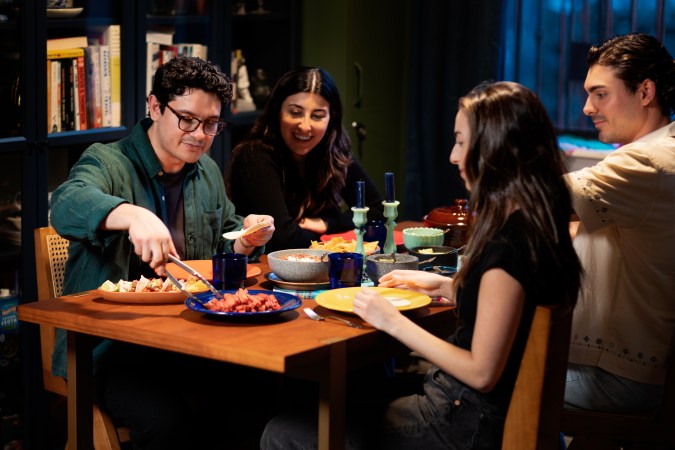
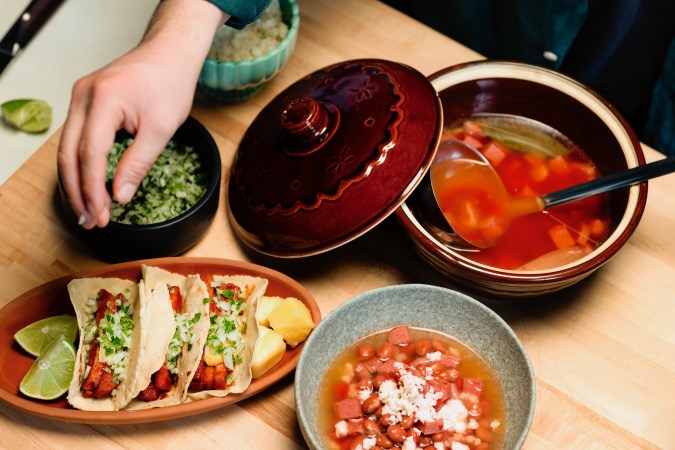
Tacos al pastor inspired the dish he will share: SPAM Classic fried in an al pastor–style sauce made with blended pineapple; dried chilies steeped like tea; garlic; onion; cloves; and a little cinnamon. On the side: beans with a few cubes of SPAM Classic, handmade tortillas, fresh white onion, and cilantro. “SPAM is a more convenient, more accessible way of making what I’d consider an extremely beloved and delicious dish,” he says. More than convenient, it’s personal. “I’m kind of excited for my house to smell like my childhood.”
Jon found SPAM by a different road. Growing up, his family’s go-to takeout was Chinese, from a restaurant where the owners greeted them like family. As he got older, Asian cuisines were the first he ventured into beyond Mexican food, and Korean cooking is where he met SPAM. “Koreans use SPAM in a lot of dishes,” he says—and that’s how he fell for it. For a while, he lived with a Korean friend, and the two swapped recipes: he taught them Mexican dishes; they taught him Korean ones.
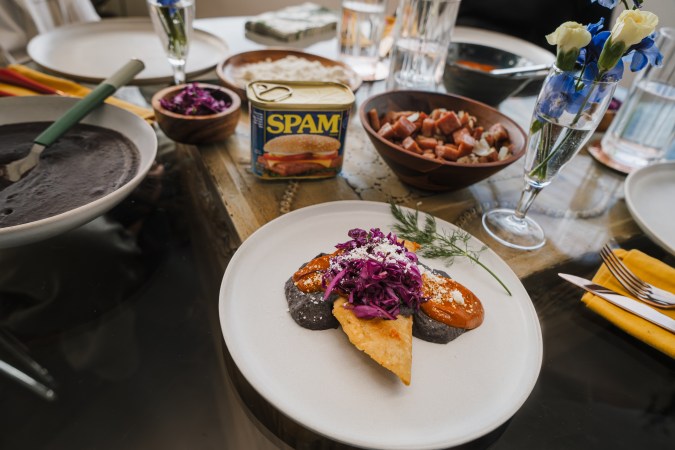
His Noche de Vecinos dish is fusion at heart: SPAM Classic fried corn quesadillas. He presses fresh corn tortillas by hand, layers in Monterey Jack and a SPAM-and-onion mixture, and—by his own admission, a little controversially—overstuffs them on purpose. “When the cheese falls out and fries into the oil, it gets crispy, like little crackly cheese pieces. That’s the best part.”
Swapping the traditional filling for SPAM keeps all the saltiness and bite of the classic, he explains, with a fusion inflection. “I love fusion dishes. There’s a lot of crossover between cultures—ingredients, ways we do things.” He thinks of it as a kind of Mexican grilled cheese: “You can put anything into a fried quesadilla, and SPAM Classic is a perfect thing to add in.”
The finishing touch is what he keeps in his fridge at all times: a tangy, crunchy pickled cabbage-and-onion cortado. “All my food has to have some kind of crunchy texture,” he says. “Once you make this, you’re going to want it all the time.”
It Was Never Really About the Food
Ask Fabrizio what he loves most about cooking for people, and he’ll admit it didn’t come naturally. His first dinner parties were, in his words, a nightmare: he sweated over the oven and was too nervous to socialize while everyone else had a good time.
But something shifted over the years. “I started realizing it’s not really about the food. It’s about what the food creates,” he reflects. He reaches for the Spanish word “ambiente”—the atmosphere, the feeling of bringing friends, family, and even strangers together.
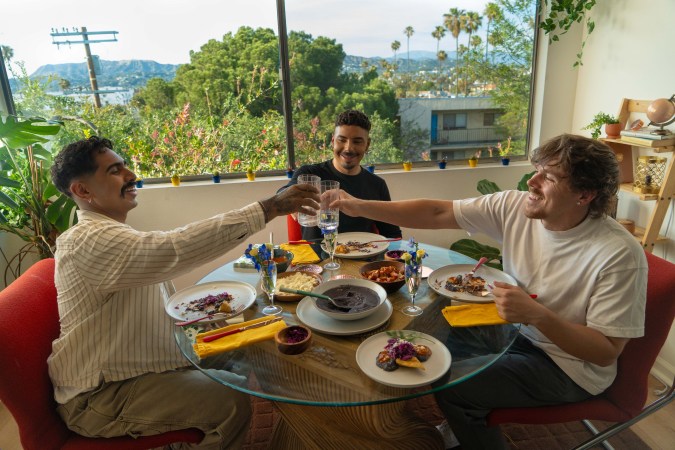
Jon knows that feeling by heart. Every Sunday, he hosts what he calls family dinners, though the guests aren’t blood. “It’s my chosen family—people I love and care about, who I’ve connected with in my adulthood.”
For him, cooking is a love language and an act of service. And SPAM, he’s found, is a small adventure he loves handing to people who’ve never tried it. “I like bringing new things to people. Being able to put it at the center of a dish, and then have someone go, ‘oh my God, this is really good,’ it opens their eyes.”
That’s the spirit of their cooking: giving something rooted in who they are, then carrying it next door to share. “Food’s a beautiful thing,” Fabrizio says. And when it smells like home, and it’s shared across a neighbor’s table, it becomes something far more meaningful than just a meal.


